Plus
$30/mo
- Credits10,000 credits

Verdict · Video · by Luma AI
Prices or limits changed on Sep 25, 2026. We are re-checking this verdict; the plan table below shows the current prices.
Pay if you need high-volume video generation or Luma Agents; the free tier is too limited for regular creators.
The button opens lumalabs.ai through shouldipay.ai/go/luma-dream-machine. It may be an affiliate link: we may earn a commission. Commissions never decide a verdict: the evidence on this page does. Disclosure
Personal
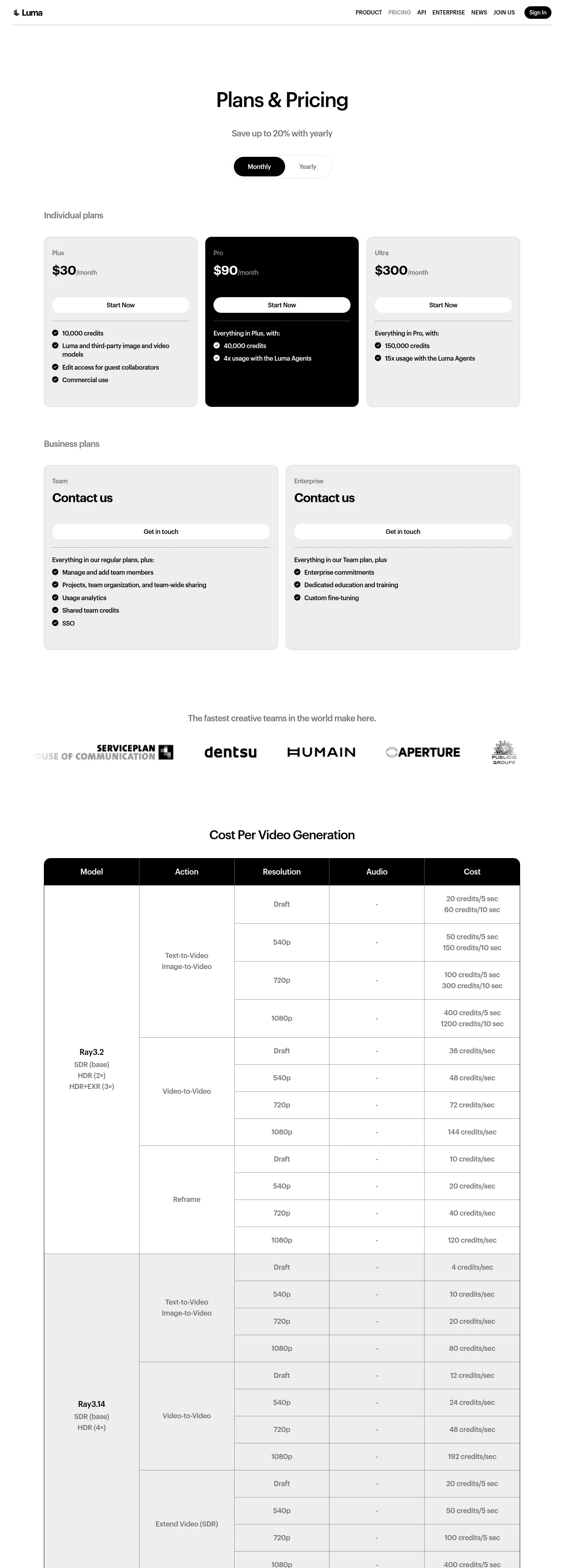
The Luma pricing page lists a free tier that allows access to Luma and third-party image and video models. The specific credit limit for the free plan is not explicitly stated in the provided source text, though the paid tiers start at 10,000 credits. The free plan typically allows for basic experimentation with tools like Text-to-Video, Image-to-Video, and various models such as Ray 3.2, Seedance 2.0, and Kling Omni. Costs vary significantly by model and resolution; for example, generating a 5-second video with Ray 3.2 SDR costs 20 credits, while the same duration with Seedance 2.0 at 480p costs 24 credits per second. Without a stated free credit limit, it is difficult to quantify exactly how many videos a free user can generate, but the jump to the first paid tier suggests the free allowance is modest.
Paying unlocks higher credit limits and advanced features. The Plus plan costs $30/month and provides 10,000 credits. This tier includes access to Luma and third-party image and video models, edit access for guest collaborators, and commercial use rights.
The Pro plan costs $90/month and provides 40,000 credits, which is four times the Plus tier. It also includes 4x usage with Luma Agents. The Ultra plan costs $300/month and provides 150,000 credits with 15x usage with Luma Agents.
Paid plans also offer access to a wide range of models with varying costs. For instance, generating a 10-second video with Ray 3.2 HDR costs 150 credits, while using Seedance 2.0 at 1080p costs 126 credits per second. The Pro and Ultra tiers are designed for users who need to scale their output significantly beyond what the Plus tier allows.
Luma Dream Machine is worth paying for if you are a regular creator or business that needs consistent, high-volume video generation. The credit system is granular, with costs ranging from 1 credit for some image generations to hundreds of credits for high-resolution video. If your usage exceeds the free tier's capacity (which is likely for anyone generating more than a few videos a week), the Plus plan at $30/month is a reasonable entry point. For teams or heavy users, the Pro and Ultra plans offer the necessary scale and agent usage. If you only need to try the tool occasionally, the free tier may suffice, but for serious work, paying is necessary to access commercial rights and sufficient credits.
Runway's Standard plan costs $12/month, which is less than Luma's Plus plan at $30/month. A free tier is also available for basic needs.
HeyGen's Creator plan is $29/month, which is slightly cheaper than Luma's Plus plan at $30/month. It includes 600 credits monthly.
Descript's Hobbyist plan is $16/month, which is cheaper than Luma's Plus plan at $30/month. It includes a free tier for light usage.
InVideo AI's Starter plan is $20/month, which is lower than Luma's Plus plan at $30/month. It offers 400 credits monthly.
The Plus plan costs $30/month.
The Pro plan includes 40,000 credits and 4x usage with Luma Agents, costing $90/month.
The source text lists commercial use as a feature of the Plus plan, implying it may not be included in the free tier, but the free tier details are not fully specified.
The Ultra plan costs $300/month and provides 150,000 credits with 15x usage with Luma Agents.
The "Visit" buttons go through shouldipay.ai/go/ and may be affiliate links, so we may earn a commission if you subscribe. Commissions never decide a verdict: the evidence on this page does. Verdicts are drafted with AI from the vendors' own pricing and documentation pages and checked automatically against those sources before they are published; a person reviews first verdicts, changed answers and anything the checks flag. Affiliate disclosure